
Buying your first home is one of the biggest financial decisions of your life — and in 2026, the market is finally beginning to shift in favor of buyers. Mortgage rates have fallen from their 2023 peak of nearly 8%, housing inventory is rising, and hundreds of assistance programs exist to help first-time buyers get into a home with far less money than most people assume.
This guide walks you through every step of the process — from checking your credit score to closing day — using the latest 2026 data so you know exactly what to expect.
What Counts as a "First-Time Home Buyer" in 2026?
Most people assume this means you have never owned a home. But for most mortgage programs, the official definition is broader: you have not owned a primary residence in the last three years. This means if you sold your home four or more years ago, you may still qualify for first-time buyer programs.
2026 Housing Market Snapshot
Before jumping into the process, here is where the market stands right now:
- Inventory rising: The number of homes for sale has increased roughly 20% compared to a year ago, giving buyers more choices and negotiating power.
- Prices stabilizing: Home price growth has slowed to a moderate pace — no longer spiking at 2021–2022 levels.
- Affordability improving: Home affordability has improved by more than $30,000 from one year ago, thanks to rising incomes and slightly lower rates.
- Rates off their peak: The 30-year fixed rate peaked near 7.8% in late 2023 — today's rates are significantly lower.
Step 1: Check Your Credit Score
Your credit score is the single biggest factor lenders use to determine your mortgage rate and whether you qualify at all. Here is what you need to know for 2026:
| Loan Type | Minimum Score | Down Payment | Best For |
|---|---|---|---|
| Conventional 97 | 620+ | 3% | Most first-time buyers |
| FHA Loan | 580+ (500 with 10% down) | 3.5% | Lower credit, flexible |
| VA Loan | No official minimum | 0% | Veterans & active military |
| USDA Loan | 640+ | 0% | Rural/suburban areas |
| Conventional (standard) | 620+ | 5–20% | Good credit buyers |
Step 2: Know How Much House You Can Afford
Lenders use your debt-to-income (DTI) ratio to decide what mortgage you can carry. This compares your total monthly debt payments to your gross monthly income.
- Front-end DTI: Your housing costs (mortgage, taxes, insurance) should not exceed 28% of gross income.
- Back-end DTI: All monthly debt payments combined should not exceed 43% of gross income for most programs.
Beyond the mortgage payment, budget for the true cost of homeownership: property taxes, homeowner's insurance, HOA fees (if applicable), maintenance (1–2% of home value per year), and Private Mortgage Insurance (PMI) if you put less than 20% down.
Calculate Your Exact Monthly Payment
Enter your home price, down payment, and loan term — see your monthly payment, total interest, and full amortization schedule instantly. Free, no signup needed.
Try Free Mortgage Calculator →Step 3: Understand Your Down Payment Options
One of the biggest myths in home buying is that you need 20% down. You do not. In 2026, most first-time buyers put down far less:
| Loan Type | Min Down Payment | On $350K Home | PMI Required? |
|---|---|---|---|
| VA Loan | 0% | $0 | No |
| USDA Loan | 0% | $0 | No |
| Conventional 97 | 3% | $10,500 | Yes (until 20% equity) |
| FHA Loan | 3.5% | $12,250 | Yes (for life of loan) |
| Conventional | 5–10% | $17,500–$35,000 | Yes (until 20% equity) |
| Conventional (no PMI) | 20% | $70,000 | No |
Step 4: Explore Down Payment Assistance Programs
In 2026, there are 2,679 active down payment assistance (DPA) programs nationwide — and most buyers have no idea they exist. These programs offer:
- Grants — free money that does not need to be repaid (often $5,000–$20,000)
- Forgivable loans — loans wiped out after you live in the home a set number of years
- Deferred second mortgages — no payments until you sell or refinance
- Tax credits — reduce your annual tax burden through Mortgage Credit Certificates (MCCs)
- Match savings programs — your savings matched dollar-for-dollar up to a limit
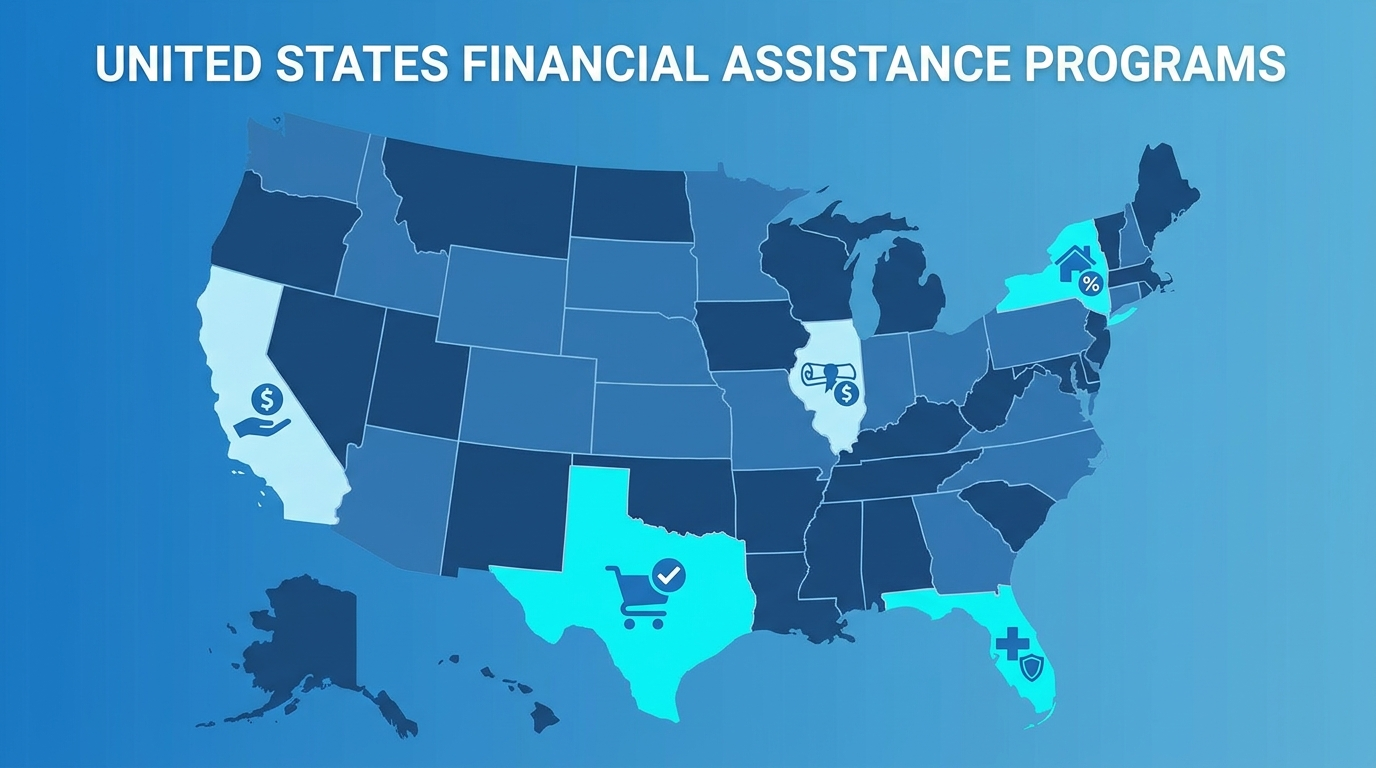
Down payment assistance programs exist in every state — most first-time buyers never look for them
Step 5: Get Pre-Approved (Not Just Pre-Qualified)
Pre-qualification is a rough estimate based on what you tell a lender. Pre-approval is a full review of your finances — credit, income, assets, and debts — that results in a conditional commitment from the lender.
Why Pre-Approval Matters in 2026
- Sellers take you seriously — especially important in competitive markets
- You know exactly how much you can borrow before touring homes
- It speeds up closing once your offer is accepted
- You avoid falling in love with a home you cannot afford
Step 6: How Your Credit Score Affects Your Rate
Your credit score is one of the biggest levers you have as a first-time buyer. Here is exactly how it affects your monthly payment on a $300,000 loan:
| Credit Score | Est. 30-yr Rate | Monthly Payment* | Total Interest Paid* |
|---|---|---|---|
| 760+ | ~6.50% | ~$1,896 | ~$382,560 |
| 700–759 | ~6.85% | ~$1,962 | ~$406,320 |
| 680–699 | ~7.10% | ~$2,011 | ~$423,960 |
| 620–679 | ~7.50% | ~$2,097 | ~$454,920 |
| Below 620 | 8.00%+ | ~$2,201+ | ~$492,360+ |
*Based on $300,000 loan, principal & interest only. Actual payments include taxes, insurance, and PMI.
Step 7: Choose the Right Loan Type
Here is a simple guide to picking the right mortgage for your situation:
Are you a veteran or active military?
Choose a VA Loan — 0% down, no PMI, and competitive rates (currently 6.0%–6.5%). This is the single best mortgage product available for eligible buyers in 2026.
Buying in a rural or suburban area?
Check if you qualify for a USDA Loan — 0% down with income limits. Use the USDA eligibility map to see if your target area qualifies.
Credit score below 700 or limited savings?
An FHA Loan is your most flexible option — 3.5% down with a 580+ credit score, and more forgiving underwriting standards than conventional loans.
Good credit, want the lowest long-term cost?
A Conventional Loan with 3%–20% down. PMI drops off automatically once you reach 20% equity — unlike FHA loans, which carry mortgage insurance for the life of the loan.
Planning to sell or refinance within 5–7 years?
A 5/1 ARM offers a lower initial rate (currently 6.0%–6.5%) fixed for 5 years before adjusting. Risky for long-term owners, but potentially smart if you know your timeline.
Step 8: Find a Home and Make an Offer
With pre-approval in hand and your loan type chosen, you are ready to start shopping.
- Work with a buyer's agent: They represent your interests and in most cases cost you nothing — the seller pays the commission.
- Do not skip the home inspection: A $300–$500 inspection can uncover problems that would cost tens of thousands to fix.
- Check the neighborhood, not just the house: Schools, commute, future development, flood zones — these all affect long-term value.
- Do not take on new debt before closing: Opening a new credit card or car loan after pre-approval can derail your mortgage entirely.
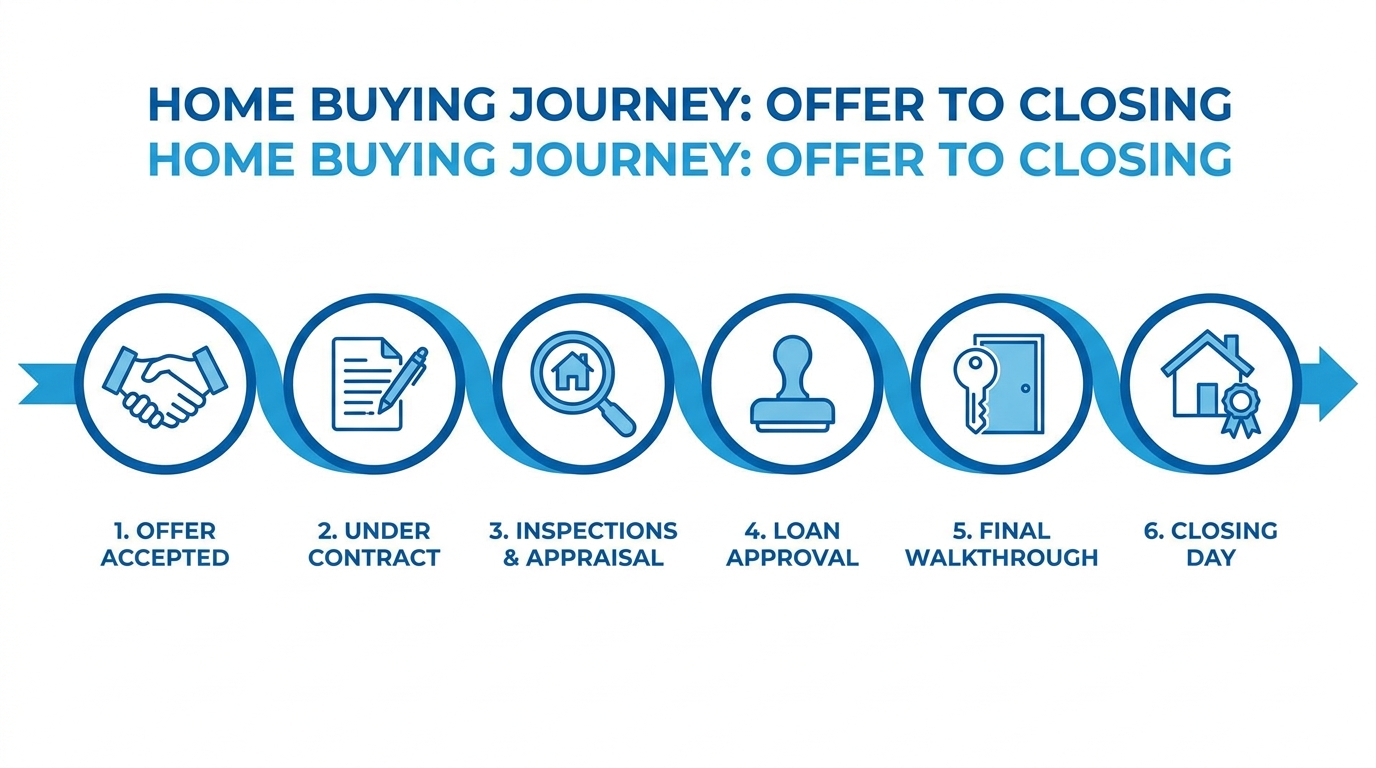
From accepted offer to closing day typically takes 30–60 days — here is what happens at each stage
Step 9: Close on Your Home
From accepted offer to closing day typically takes 30–60 days. Here is what happens during that time:
- Your lender orders an appraisal to confirm the home's value matches the purchase price
- A title company checks for any ownership issues or liens on the property
- You review and sign your final Closing Disclosure — a detailed breakdown of all loan costs
- You do a final walkthrough of the home within 24 hours of closing
- You pay closing costs — typically 2–5% of the loan amount — and sign all documents
- You get your keys!
Plan Your Full Budget Before You Buy
Use our free Budget Planner to make sure homeownership fits into your complete financial picture — mortgage, savings, debt, and monthly expenses all in one place.
Open Budget Planner →Common First-Time Buyer Mistakes to Avoid
- Assuming you need 20% down and not exploring other loan options
- Buying more home than you can comfortably afford
- Underestimating total ownership costs beyond the mortgage payment
- Skipping the home inspection to save a few hundred dollars
- Opening new credit accounts or making large purchases before closing
- Not maintaining an emergency fund after buying — aim for 3–6 months of expenses
- Making decisions purely on emotion rather than the actual numbers
- Not shopping multiple lenders — rates can vary by 0.5% or more
Should I Buy in 2026 or Wait?
Buy Now If:
- You have found a home you love at a price you can comfortably afford
- Your budget works at current rates without stretching
- You plan to stay in the home for at least 5–7 years
- Your local market has rising inventory and motivated sellers
Consider Waiting If:
- Your credit score is below 620 — a few months of improvement saves thousands
- You do not yet have enough for a down payment plus closing costs plus emergency fund
- Your job or income situation is uncertain
- The monthly payment would exceed 30% of your take-home pay
First-Time Home Buyer Checklist 2026
- Check your credit score — aim for 620+ minimum, 700+ for best rates
- Calculate your budget using DTI ratio and true ownership costs
- Research down payment assistance programs in your state
- Choose the right loan type for your situation (VA, USDA, FHA, or Conventional)
- Get pre-approved by at least 3 lenders and compare offers
- Find a buyer's agent you trust
- Tour homes and make a competitive offer within your budget
- Schedule a professional home inspection
- Review Closing Disclosure carefully before signing
- Do a final walkthrough and close — get your keys!
Frequently Asked Questions
How much do I need to buy a house for the first time in 2026?
You can buy with as little as 3% down on a conventional loan or 3.5% down on an FHA loan. On a $350,000 home, that is $10,500–$12,250. You also need closing costs (2–5% of the loan) and ideally an emergency fund. Down payment assistance programs can cover some or all of the down payment and closing costs.
What credit score do I need to buy a house in 2026?
The minimum is 620 for most conventional loans and 580 for FHA loans with 3.5% down. A score of 700 or above gets you significantly better rates. A score of 760+ earns you the best rates available, potentially saving $40,000+ over a 30-year loan.
What is the current mortgage rate for first-time buyers in 2026?
As of August 2026, the average 30-year fixed rate is 6.5%–7.0%. FHA loans average around 6.25%–6.75% and are often the best option for first-time buyers with lower credit scores or smaller down payments. VA loans for eligible veterans average 6.0%–6.5% with no down payment required.
Should I buy a house in 2026 or wait?
For most first-time buyers, 2026 offers better conditions than 2023 or 2024 — rates are off their peak, inventory is rising, and affordability has improved. If the numbers work today, waiting for "perfect" conditions often costs more than it saves. If rates drop later, refinancing is always an option.
Key Takeaways
- You do not need 20% down — most first-time buyers put down 3–3.5%
- The 30-year fixed rate is around 6.5%–7.0% in August 2026, down from 7.8% in 2023
- There are 2,679 active DPA programs nationwide — find yours before assuming you cannot afford to buy
- VA and USDA loans offer 0% down for eligible buyers
- Get pre-approved by at least 3 lenders — rates vary more than most buyers realize
- Improving your credit score from 680 to 760 can save $41,400 over 30 years
- The full home buying process from accepted offer to closing typically takes 30–60 days
Ready to Run the Real Numbers?
Use Monemint's free calculators to see exactly what you can afford before you start shopping.
Try Mortgage Calculator →This article is for informational purposes only and does not constitute financial or mortgage advice. Mortgage rates, loan limits, and program eligibility change frequently. Always verify current rates with your lender and consult a licensed mortgage professional before making home-buying decisions.