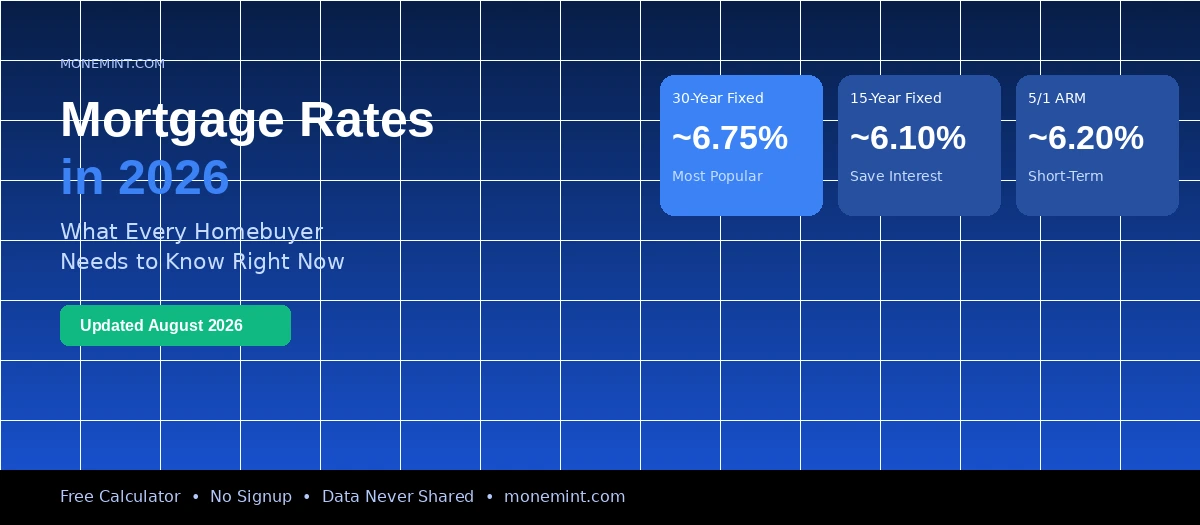
Current Mortgage Rates: August 2026
If you're shopping for a home right now, understanding where mortgage rates stand is the first step to making a smart financial decision. Rates have remained elevated compared to the historic lows of 2020–2021, but they have shown signs of gradual easing through mid-2026.
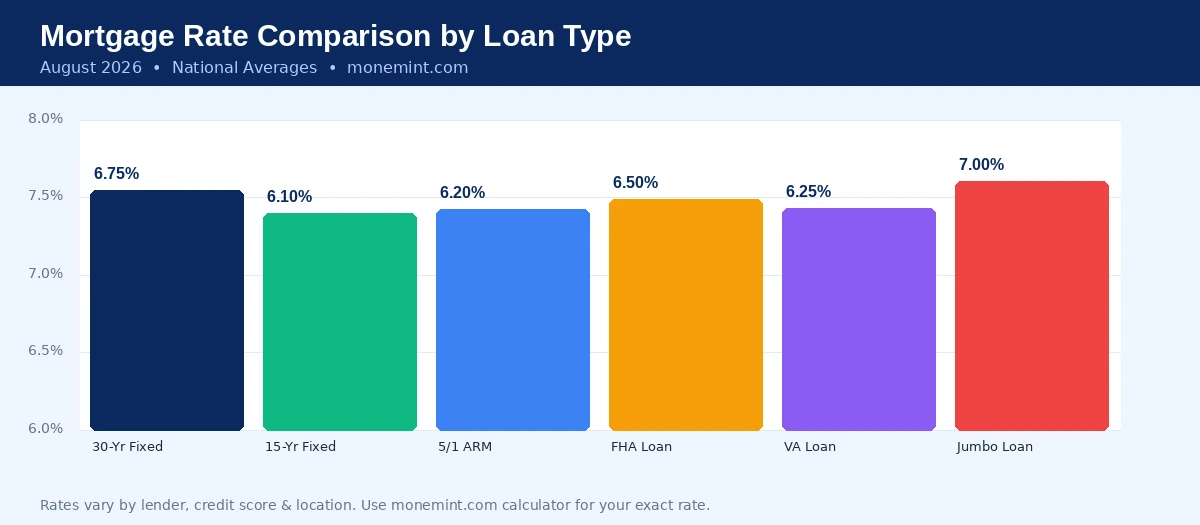
Comparison of mortgage loan types and their average rates in August 2026
What Is Driving Mortgage Rates in 2026?
Mortgage rates don't move randomly — they're tied to several key economic factors. Here's what's shaping the rate environment right now:
1. The Federal Reserve's Policy
The Fed doesn't directly set mortgage rates, but its decisions have a major ripple effect. After aggressive rate hikes in 2022–2023, the Fed began cutting rates in late 2024. In 2026, the Fed has continued a cautious easing path, which has helped bring mortgage rates down slightly from their 2023 peaks above 8%.
2. The 10-Year Treasury Yield
The 30-year fixed mortgage rate closely tracks the 10-year U.S. Treasury yield. When Treasury yields rise, mortgage rates rise too. In 2026, the spread has remained slightly elevated due to uncertainty in the mortgage-backed securities market.
3. Inflation
Lenders need to earn a return above the rate of inflation. The gradual cooling of inflation through 2025–2026 has been one of the key reasons rates have edged lower from their peaks.
Mortgage Rate Comparison by Loan Type
Not all mortgages are equal. Here's a detailed look at common loan types and what rates to expect:
| Loan Type | Avg Rate (Aug 2026) | Best For | Down Payment |
|---|---|---|---|
| 30-Year Fixed | 6.50%–7.00% | First-time buyers | 3%–20%+ |
| 15-Year Fixed | 5.90%–6.40% | Pay off faster & save interest | 3%–20%+ |
| FHA Loan | 6.25%–6.75% | Lower credit scores (580+) | 3.5% |
| VA Loan | 6.00%–6.50% | Veterans & active military | 0% |
| 5/1 ARM | 6.00%–6.50% | Selling or refinancing within 5 yrs | 5%–20% |
| Jumbo Loan | 6.75%–7.25% | Loans above $766,550 | 10%–20%+ |
Find Your Exact Monthly Payment
Enter your home price, down payment, and loan term — our free calculator shows your monthly payment, total interest, and full amortization schedule instantly.
Calculate My MortgageHow to Get the Best Mortgage Rate in 2026
Your rate isn't just determined by the market — your personal financial profile matters enormously. Here are the most powerful steps you can take:
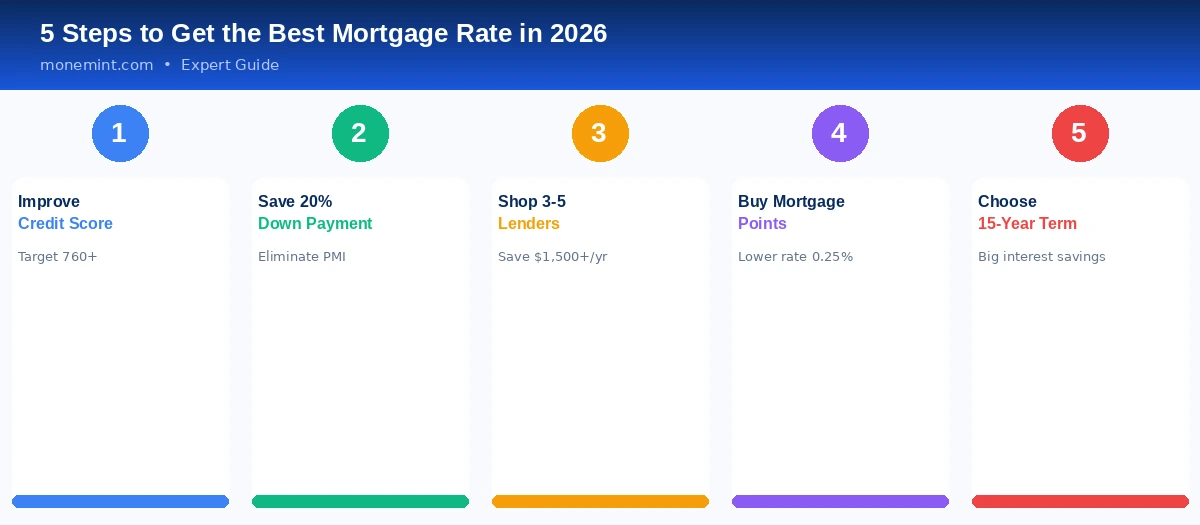
5 proven steps to lower your mortgage rate and save thousands over the life of your loan
Improve Your Credit Score
A score of 760 or above gets you the best rates. Going from 700 to 760 can save you 0.25%–0.50% — translating to tens of thousands in savings over 30 years.
Save a Larger Down Payment
A 20% down payment eliminates PMI and often earns you a better rate. Even 10% down vs. 5% can improve your rate slightly.
Shop Multiple Lenders
Getting quotes from at least 3–5 lenders can save you an average of $1,500 in the first year alone. Check banks, credit unions, and online lenders.
Consider Buying Mortgage Points
Each "point" costs 1% of your loan and reduces your rate by about 0.25%. If you plan to stay 7+ years, buying points usually pays off.
Choose a Shorter Loan Term
A 15-year loan carries a lower rate than a 30-year loan. The monthly payment is higher, but total interest paid is dramatically less.
How Credit Score Affects Your Mortgage Rate
Your credit score is one of the biggest levers you have. Here's exactly how the two are connected:
| Credit Score | Loan Type | Est. 30-yr Rate | Monthly Payment* |
|---|---|---|---|
| 760+ | Conventional (best) | ~6.50% | ~$1,896 |
| 700–759 | Conventional | ~6.85% | ~$1,962 |
| 680–699 | Conventional / FHA | ~7.10% | ~$2,011 |
| 620–679 | FHA | ~7.50% | ~$2,097 |
| Below 620 | FHA only | 8.00%+ | ~$2,201+ |
*Based on $300,000 loan, principal & interest only. Actual payments include taxes, insurance, and PMI.
Should You Lock In Your Rate Now or Wait?
Lock Now If:
- You've found a home you love at a price you can afford
- Your budget works comfortably at current rates
- You're worried rates might rise before closing
Consider Waiting If:
- Strong economic data suggests rates may fall soon
- You're not under any time pressure to buy
- Your lender offers a "float down" option
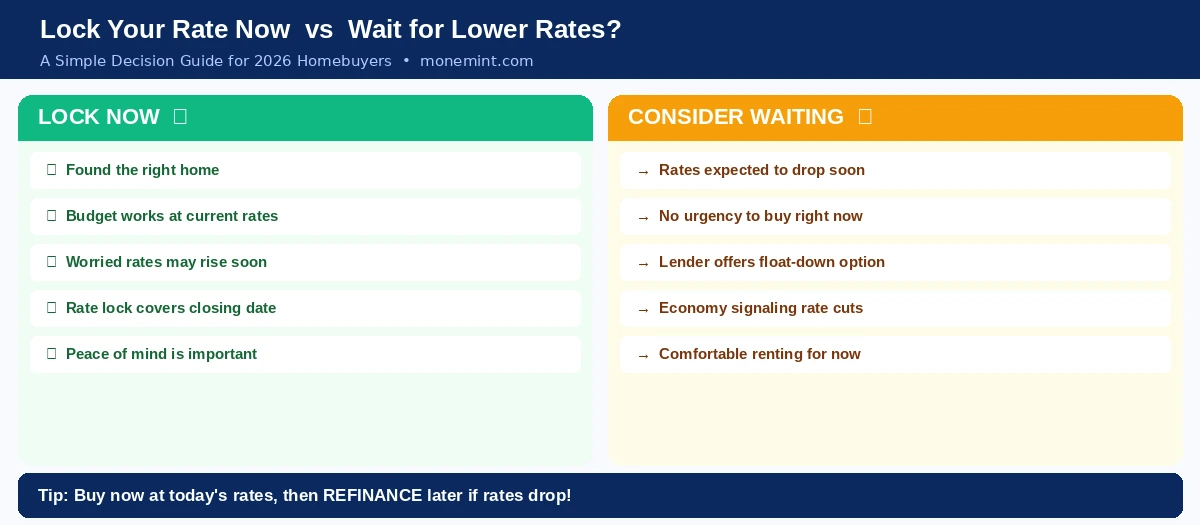
Rate lock vs. waiting — a simple decision guide for 2026 homebuyers
Frequently Asked Questions
What is the current mortgage rate in 2026?
As of August 2026, the average 30-year fixed mortgage rate is approximately 6.5%–7.0%. The 15-year fixed rate averages around 5.9%–6.4%. Your actual rate depends on your credit score, down payment, loan type, and lender.
Will mortgage rates go down in 2026?
Most economists expect rates to gradually ease through the remainder of 2026. However, rates are very unlikely to return to the 3%–4% lows of 2020–2021. The consensus is for rates to remain in the 6%–6.5% range by end of 2026 if inflation continues to cool.
How can I get the lowest mortgage rate in 2026?
The most effective strategies: raise your credit score to 760+, save a 20% down payment, compare offers from at least 3–5 lenders, consider buying discount points, and choose a 15-year term if you can manage the higher payment.
Should I buy a home now or wait for lower mortgage rates?
If you can comfortably afford a home at today's rates and you've found the right property, buying now often makes sense. Remember: you can always refinance later if rates drop, but you can't go back and buy the home you missed.
See How Much You Can Afford
Use our free mortgage calculator to calculate your monthly payment, total interest, and full amortization schedule — no signup required.
Try Free Mortgage CalculatorKey Takeaways
- The average 30-year mortgage rate in August 2026 is 6.5%–7.0%
- Rates are influenced by the Fed, Treasury yields, and inflation
- A 760+ credit score can save you tens of thousands over the life of your loan
- Always compare at least 3–5 lenders — rates vary more than most buyers realize
- If the numbers work at today's rates, don't wait — you can always refinance later
This article is for informational purposes only and does not constitute financial or mortgage advice. Mortgage rates change daily. Always verify current rates with your lender and consult a licensed mortgage professional before making home-buying decisions.